
Introduction Category: Medicine, Artificial Intelligence, Productivity & Automation
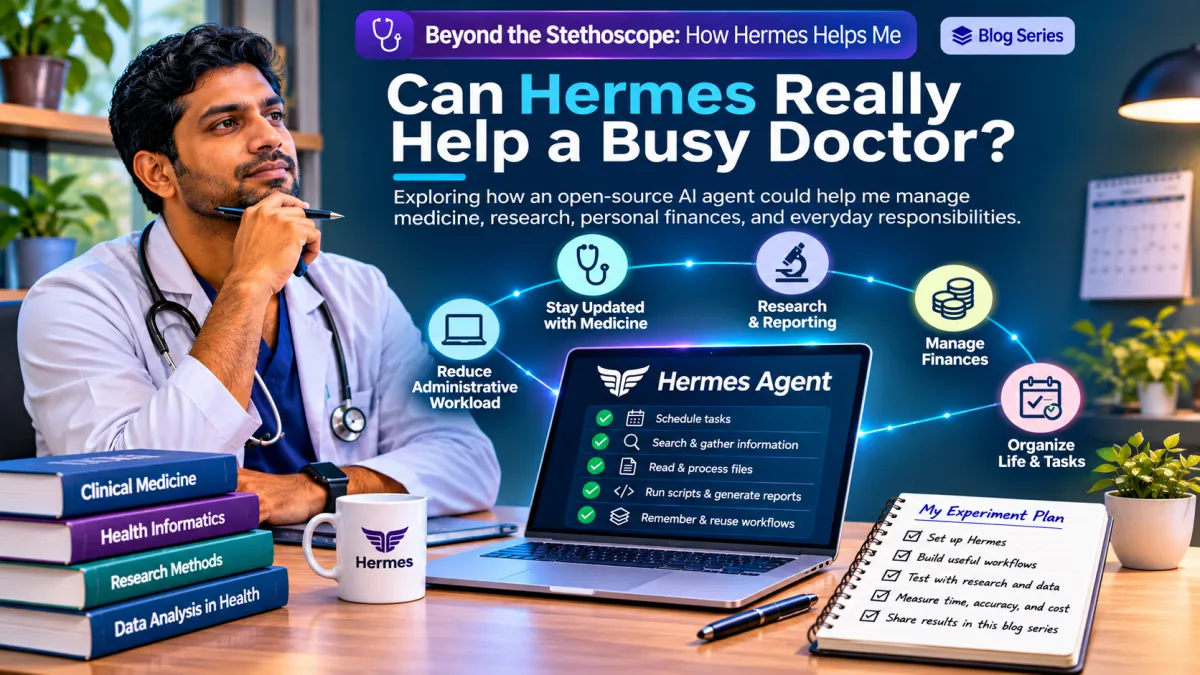
Can Hermes Really Help a Busy Doctor? Exploring how an open-source AI agent could help me manage medicine, research, personal finances, and everyday responsibilities.
Series: Beyond the Stethoscope: How Hermes Helps Me
Introduction Category: Medicine, Artificial Intelligence, Productivity & Automation
Being a Doctor Doesn't End When the Shift Ends Being a doctor is so much more than diagnosing diseases, treating patients and making clinical decisions. Not to mention the side hustle of programming!. There is another side of professional life that often receives less attention. Medical professionals need to constantly update their knowledge, manage their professional responsibilities, keep track of appointments, complete administrative work, organise personal finances and find time for family and personal development.
For doctors involved in research or technology, these responsibilities can become even more complicated. A typical week might involve clinical duties, reading medical literature, working on research projects, preparing reports, responding to emails, and managing everyday financial obligations. Each activity may appear manageable individually. The difficulty comes from constantly switching between them. This led me to an interesting question: What if an AI agent could help me manage the work surrounding medicine, so I could devote more attention to the responsibilities that genuinely require my knowledge and judgement? That question brought me to Hermes Agent.
What Exactly Is a Hermes Agent?
Hermes Agent is an open-source AI agent developed by Nous Research. Unlike a conventional chatbot that primarily responds to individual questions, an AI agent can use software tools to perform sequences of tasks. Depending on its configuration, Hermes can: Search the internet and retrieve information. Read, organise, and process files. Execute scripts and interact with software tools. Remember relevant information across conversations. Perform scheduled activities. Use browser automation for supported workflows. Connect with external services through configured integrations. Reuse documented procedures through its skills system. These capabilities open up possibilities beyond simply asking an AI model to summarise a document.
For example, instead of repeatedly requesting an update on medical research, I could potentially configure the agent to collect information from selected sources at regular intervals, prepare a summary, and present it for my review. The distinction is important.
A chatbot answers a question. An agent may be able to execute a workflow. However, an agent's ability to execute tasks does not guarantee that those tasks will be accurate, secure, or genuinely useful. That is precisely what I want to examine.
Could Hermes Help Me Stay Updated with Medicine?
Medicine changes continuously. New clinical guidelines, systematic reviews, research findings, diagnostic technologies, and treatment recommendations appear regularly. Staying informed is a professional responsibility, but identifying which developments are relevant can be time-consuming. One of my first ideas is to build a personalised medical literature monitoring workflow. Imagine receiving a structured briefing each morning containing: Newly published studies from selected journals. Recent systematic reviews relevant to my clinical interests. Important guideline updates from recognised organisations. Developments in digital health and medical informatics. Research articles worth reading in greater detail. Rather than searching multiple websites independently, I could use Hermes to help collect and organise this information. For example, I might give it a task such as:
Every Monday, identify newly published systematic reviews relating to hypertension, diabetes, and digital health. Provide the article titles, publication dates, DOI links, study types, and brief summaries. Clearly identify any information that could not be verified.
This would not replace reading the original research. AI-generated summaries can omit important limitations, misinterpret findings, or occasionally produce incorrect citations. The sources, conclusions, and relevance would still require verification. My objective would be to improve information discovery, not delegate medical judgement.
Could Hermes Help Me Manage My Research Projects?
Research is an area where I see particularly strong potential. A research project involves much more than just analysing data. It can include literature searches, reference management, dataset preparation, data validation, statistical analysis, report generation, documentation, and tracking revisions. These activities often involve repeatable steps. Consider a research project using a publicly available health dataset. A potential Hermes-assisted workflow might be: Read the dataset and its documentation. Identify variables, missing values, and unexpected data types. Generate a preliminary data-quality report. Execute a predefined Python analysis script. Produce tables and visualisations. Record the transformations and analysis methods. Prepare a draft report for manual review. This would be an intriguing experiment because the outputs could be evaluated objectively. I could compare an agent-generated report against a manually verified analysis and identify errors, omissions, and unnecessary complexity. I am also interested in whether Hermes can help maintain reproducible research workflows.
A useful research assistant should not simply produce attractive charts. It should help preserve the methods, code, data provenance, assumptions, and limitations behind them. For demonstrations, I would use public, appropriately licensed, or clearly synthetic datasets rather than confidential patient information. Can Hermes Help Me Manage My Personal Finances? Financial management is another important part of a doctor's life. Professional responsibilities do not eliminate everyday financial concerns. Income, household expenses, transportation, professional subscriptions, education costs, savings, debt, and unexpected expenditure all require attention. For doctors with additional professional commitments, financial administration may become more complicated. I am interested in experimenting with Hermes as a personal financial organisation assistant. Tracking income and expenditure My first experiment would involve a simple spreadsheet containing categorised income and expenses. Using synthetic financial records initially, I could ask Hermes to analyse spending patterns and generate a monthly summary. For example: Analyse this sample monthly expense spreadsheet. Categorise the transactions, identify recurring expenditure, compare the categories against the previous month, and produce a summary with charts. Do not modify the source file. A useful output might identify changes in transportation expenses, recurring subscriptions, professional expenditure, or household costs.
What About My Life Outside Medicine?
One of the more interesting possibilities is using Hermes as a general personal administration assistant. Medical professionals are still responsible for the same everyday activities as everyone else. Bills must be paid. Insurance policies need renewing. Vehicles need servicing. Appointments must be remembered. Household responsibilities must be managed. These obligations may appear minor, but collectively they consume time and attention. I would like to experiment with workflows that track: Important personal deadlines. Professional registration and renewal reminders. Vehicle servicing and maintenance schedules. Household administrative tasks. Personal learning goals. Progress on independent projects. The value would not necessarily come from complicated artificial intelligence. Sometimes, a reliable reminder and a well-organised checklist are more useful than an advanced autonomous workflow. That raises an important question I intend to revisit throughout this series: When is an AI agent actually better than a calendar, spreadsheet, or simple automation script? If a conventional tool can solve a problem more reliably and at lower cost, that may be the better choice. Privacy, Security, and Professional Responsibility There is an essential boundary when exploring AI agents in medicine. Healthcare information is sensitive. Clinical environments have strict professional, ethical, confidentiality, and security requirements. An AI agent capable of accessing files, executing commands, and connecting with online services can create significant risks if configured carelessly. My first experiments will be on personal tasks, publicly available research, and synthetic datasets. I'm also hosting the agent on my server. I’m not using identifiable patient records, confidential hospital documents, or restricted institutional systems in these experiments. I would also avoid giving an autonomous agent authority to make clinical decisions, issue prescriptions, alter patient records, or communicate clinical instructions without appropriate professional and institutional safeguards. Even when a platform provides security controls, these must be properly configured and tested. For me, the responsible approach is to begin with minimal permissions, restrict access to necessary tools, maintain human approval for sensitive actions, and review the results. An AI agent is not a substitute for clinical competence, professional accountability, or institutional authorisation.